




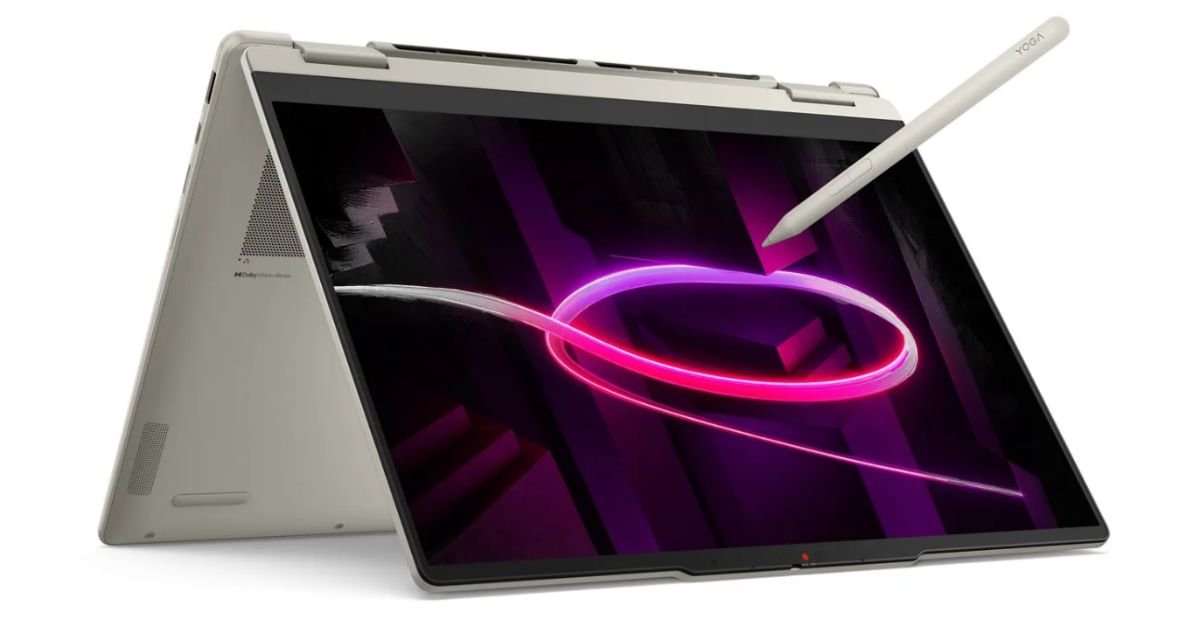
Lenovo has refreshed its Yoga 7a 2-in-1 lineup at CES 2026, introducing new models powered by AMD’s Ryzen AI 400 “Gorgon Point” APUs and pairing them with high-end OLED displays aimed at creators and mobile professionals.
Specs and Features
The updated Yoga 7a is built around AMD’s Ryzen AI 7 445 APU, a 6-core, 12-thread processor based on the Zen 5 architecture, internally codenamed “Gorgon Point.” Graphics are handled by the integrated Radeon 840M GPU, with no discrete GPU option offered.
Both sizes feature OLED panels with a 2880×1800 resolution, 120Hz refresh rate, and peak brightness of up to 1,000 nits. Lenovo claims 100% DCI-P3 colour coverage and Delta E values below 1, positioning the display for colour-sensitive work.
Memory configurations go up to 32GB of LPDDR5X-7500 RAM, paired with up to 2TB of PCIe Gen4 SSD storage. Power comes from a 70Wh battery with 65W USB-C charging.
Design
A 360-degree hinge enables the Yoga 7a to switch seamlessly between laptop and tablet modes, making it ideal for tasks such as drawing, note-taking, and presentations.
The 14-inch model weighs 1.4kg (3 lbs), while the 16-inch version comes in at 1.8kg (3.9 lbs). A four-speaker system with dual woofers and tweeters handles audio.
Connectivity includes dual USB-C ports (10Gbps), USB-A (10Gbps), HDMI 2.1, an audio jack, and an SD card reader, alongside Wi-Fi 7 and Bluetooth 5.4. A 5MP front camera with IR support is also included.
Price and Availability
The 14-inch Lenovo Yoga 7a will start at $849, while the larger 16-inch model is priced from $899. Lenovo is targeting creators, students, and professionals seeking a versatile convertible, with availability planned for Q2 2026. An exact launch date has not yet been announced.
By combining high-brightness OLED panels with AMD’s Zen 5-based Ryzen AI platform, Lenovo is positioning the Yoga 7a as a capable, lighter alternative to its previous generation, particularly for users who value portability, tablet flexibility, and colour-accurate displays.